

Fifteen-year-old Ben has never scored the winning goal. His grandparents, however, cheer like he has won the Stanley Cup every time he touches the puck.
His mother brings the Cabin Issue throw. His father brings coffee from Comet Coffee. Grandpa Stan brings a cowbell that has embarrassed three generations of children.
It's a Saturday afternoon in Ann Arbor, and the entire family has assembled for another youth hockey game.
Stan owns three cowbells, though the family has only seen one. He says the others are 'for special occasions,' a statement Ben considers a threat. The rink smells of sharpened blades, coffee and the rubber mats that never quite dry. Parents settle into their familiar positions along the boards, exchanging news about work and weather. Ben laces up in the locker room and tries to ignore his phone. His coach has been telling him to stop looking for the big play and notice the small ones: the pass into space, the shift change, the teammate who needs a word after a mistake. None of that makes for a heroic highlight reel, and Ben knows he isn't the player scouts come to see. But when he looks up into the stands during warmups, there is his grandmother waving like he has just stepped onto an international stage. Stan is already holding the bell. Ben pretends he cannot see either of them.
When the puck drops, Stan stands for so long that Ben's mother tugs the back of his coat. He sits, then stands again twenty seconds later. Ben's grandfather has never really learned how to watch a game quietly. At home he's a measured, soft-spoken man who labels everything in the garage and alphabetizes the spice cupboard. At the rink, the cowbell appears to operate some different part of his personality. Ben hears it during a line change and feels the familiar mixture of mortification and delight. The team has been struggling, and he has been hard on himself after practices. He doesn't tell his family how often he imagines making one spectacular play that would justify every early alarm and late-night drive. His grandmother sees the pressure in his shoulders. When he glances toward the stands, she doesn't wave this time. She simply nods, as though to say, play your game.
The game is fast and uneven. Ben wins a puck along the boards, loses another, and manages a smart pass that almost becomes a goal. From the stands his grandmother shouts his name with the force of a stadium announcer. He knows his friends can hear. In the third period, his team is down one and tries to mount a comeback. Ben is exhausted. He gets caught behind the play, and the other team scores into an empty net. Walking off the ice, he stares at the tape on his stick because it is easier than meeting anyone's eyes. Grandma waits without saying 'you did great' immediately. She asks if he wants water. Stan folds the cowbell into his coat. Then they talk about one excellent play Ben made in the second period, a moment he thought nobody noticed. At the Fleetwood Diner afterward, squeezed into its tiny downtown room, pancakes arrive larger than the plates. The conversation wanders to school and to his little cousin's birthday. Ben reaches for more syrup and realizes the loss is no longer the only thing he remembers. Stan asks whether the bell was too much. Everyone at the table says yes. He says he'll consider it.
The cowbell rides home in the trunk. By family agreement.
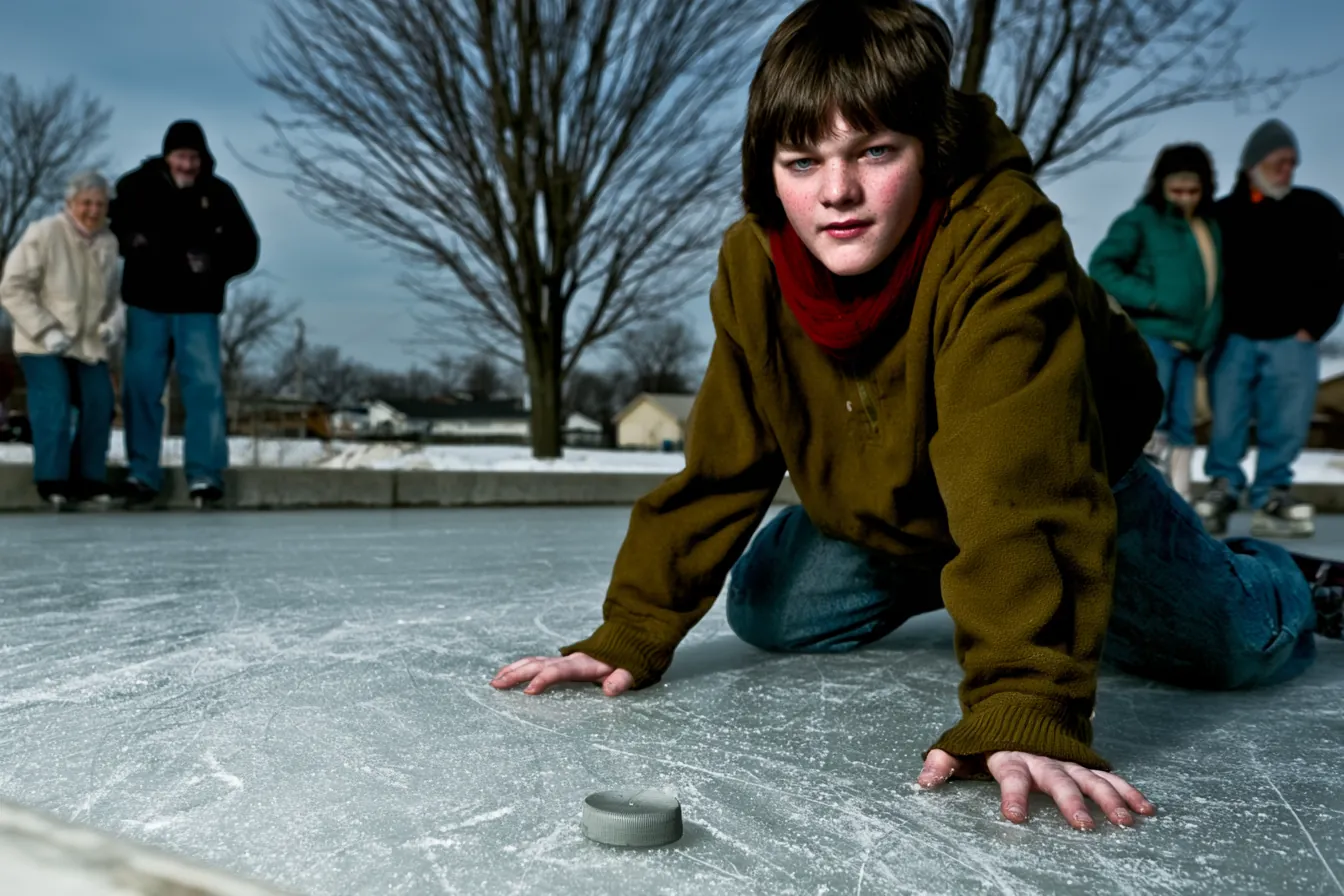
Setting artwork is illustrative; it does not depict the story’s cast or document an event.